Category: Maximalism

  • A Colorful Maximalist Vanity Corner Built From Sunbursts, Leopards, And Party Stripes

    A Colorful Maximalist Vanity Corner Built From Sunbursts, Leopards, And Party Stripes

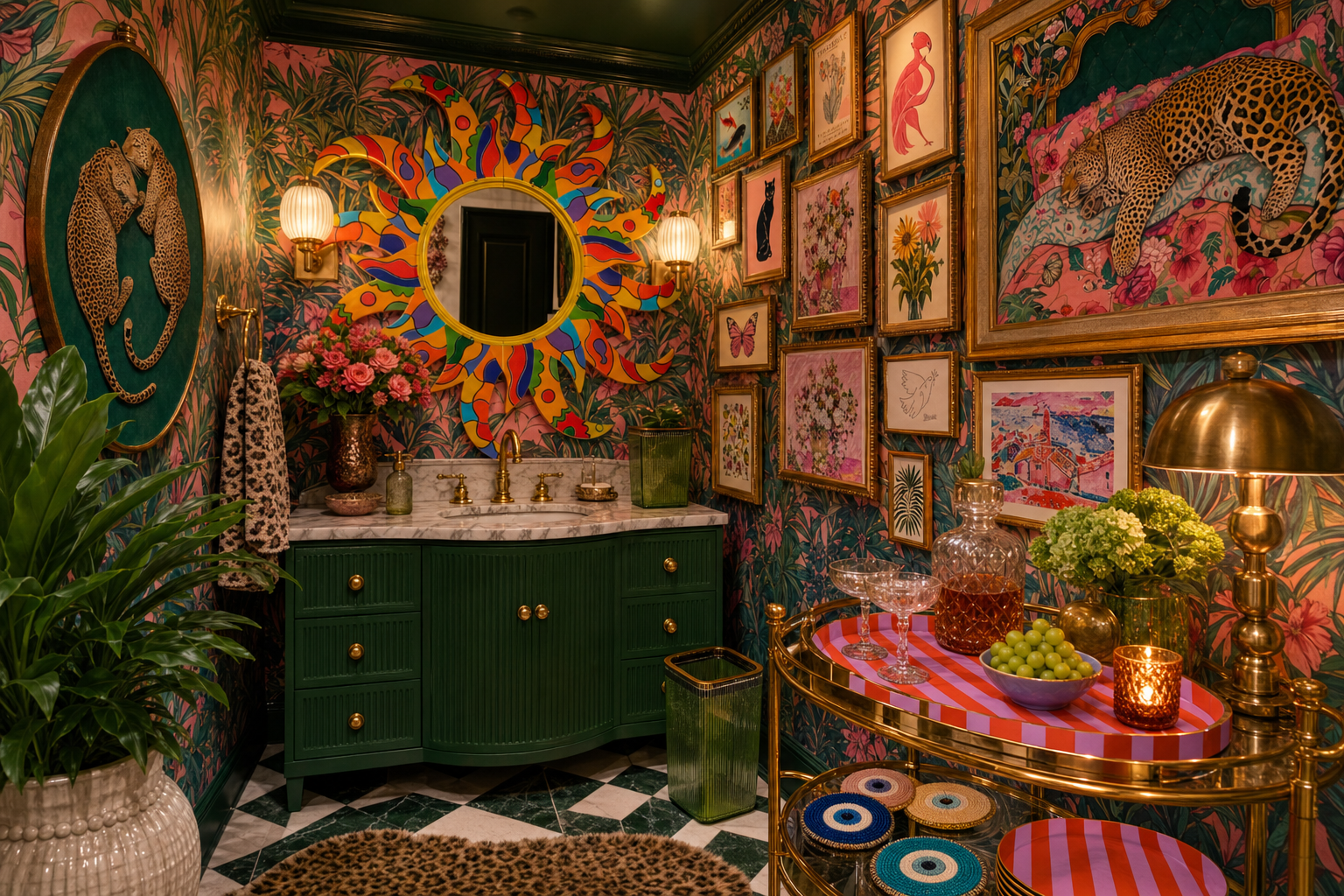
    This vanity corner is what happens when useful little pieces stop apologizing and join the party. It has the confidence of a boutique hotel powder room, the playfulness of a late-afternoon cocktail table, and just enough jungle drama to keep the whole setup from feeling sweet. The look is colorful, yes, but not random: it is built from citrus brights, emerald greens, graphic stripes, animal art, and glossy moments that bounce light around a small space.

    The key move is treating the vanity area like a tiny room-within-a-room. A mirror becomes the anchor, art becomes the atmosphere, and tabletop pieces become part of the palette rather than afterthoughts. If you’re shopping through affiliate links or recreating the look piece by piece, start with the big visual note first, then layer in the smaller practical objects that make the corner feel lived-in.

    Why This Maximalist Vanity Corner Works

    This room works because it has a strong center of gravity. The colorful sunburst mirror gives the eye an obvious place to land, which is essential in a maximalist space. Without that kind of anchor, a gallery wall can start to feel like a pile-up. Here, the mirror acts almost like a decorative sun: everything else orbits around it, from the emerald animal art to the striped plates on the surface below.

    The palette is also smarter than it first looks. Orange, lilac, green, and jewel-toned emerald could easily become chaotic, but they are repeated at different scales. You get big color in the mirror, deeper color in the wall art, translucent green in the bin, and smaller bursts of pattern through coasters and plates. That repetition makes the room feel collected instead of cluttered. It is maximalism with a rhythm.

    The Styled Room

    See How The Pieces Work Together
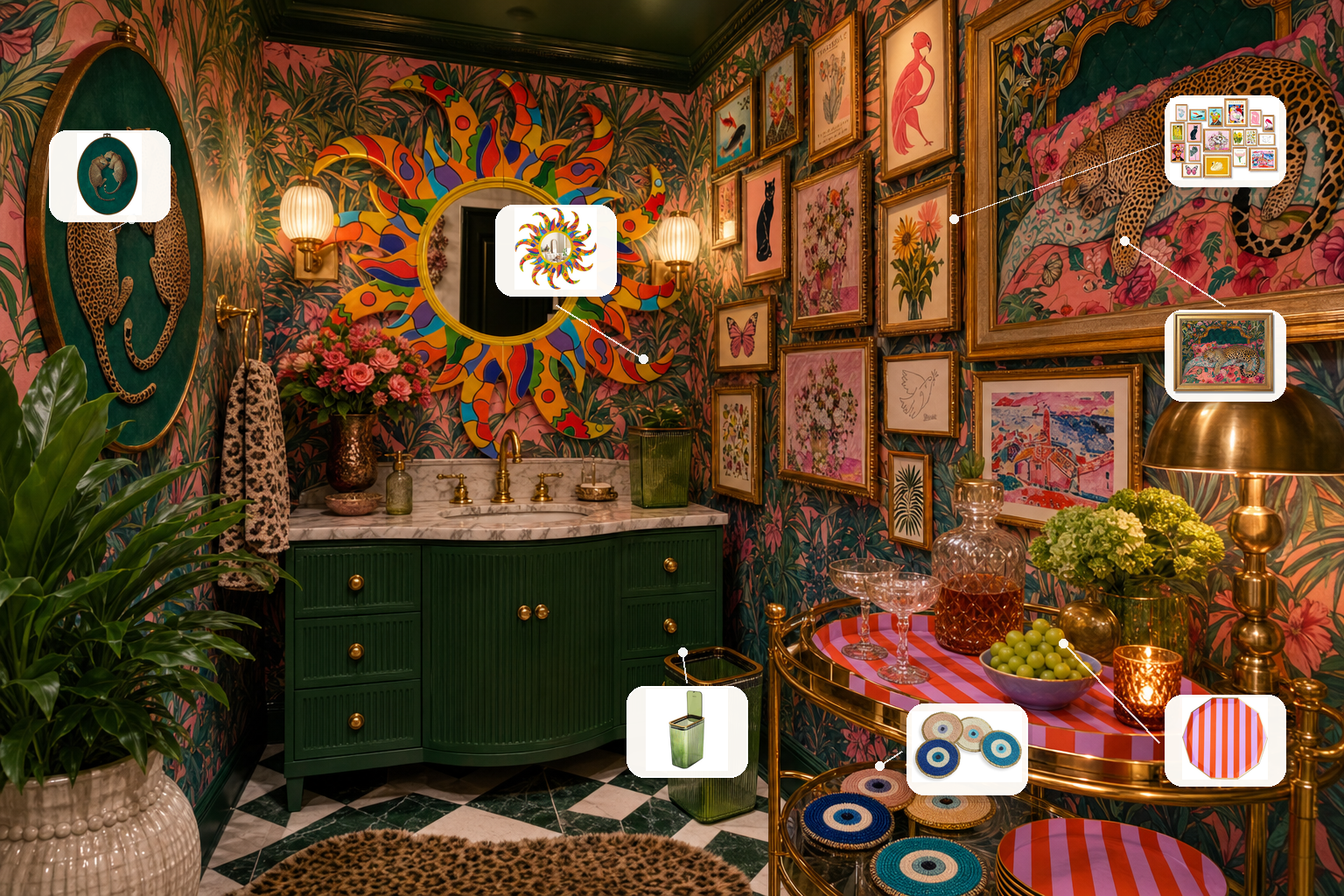
    Room Decode styled room with product callouts

    Translucent Green Lidded Bin

    A small-space vanity corner always needs somewhere to hide the not-so-pretty things: hair tools, extra skincare, cotton pads, backup candles, cords, samples, all of it. The trick is not pretending storage doesn’t exist. The trick is choosing storage that speaks the same design language as the rest of the room. A translucent green lidded bin does exactly that. It reads as glassy, fresh, and intentional rather than purely utilitarian.

    The green is the important part. In this palette, it can echo plants, emerald artwork, and glossy accessories, so the bin disappears into the story instead of fighting it. Place it under the vanity, beside a small console, or on a lower shelf where it catches light but doesn’t dominate. Because it is translucent, it has a lighter visual footprint than an opaque plastic box, which matters in a maximalist corner where the wall is already doing a lot.

    Colorful Sunburst Wall Mirror

    The colorful sunburst wall mirror is the piece that gives this corner its heartbeat. A vanity mirror has to be functional, but it does not have to be quiet. The radiating shape brings movement, and the color turns a practical daily-use object into the room’s main focal point. Hang it above a slim vanity, petite writing desk, or narrow console so it sits at eye level and immediately announces the mood.

    What makes this mirror especially useful in a maximalist setup is its ability to organize the surrounding chaos. The circular center gives you reflection and light, while the sunburst frame adds edge, color, and shape. If the room is small, that reflection helps open up the corner. If the room is plain, the mirror supplies instant architecture. It is the piece I’d choose first, then build the gallery wall around it rather than treating it as an accessory later.

    Emerald Cheetah Oval Wall Art

    The emerald cheetah oval wall art brings the moodier note this room needs. Bright maximalism can become all candy if there is no depth, and this piece adds that deeper, jewel-box layer. The emerald background feels lush and saturated, while the paired cheetahs introduce symmetry, drama, and a little bit of old-world glamour. It is bold, but in a more controlled way than the sunburst mirror.

    Use it as the counterweight to the brighter pieces. If the mirror sits in the center, this artwork can live slightly off to one side, creating a visual conversation rather than a perfectly matched arrangement. The oval shape is also a gift in a gallery wall because it breaks up all the hard rectangles. Pair it with smaller prints nearby, or let it sit close to the mirror to create a tight, impactful vanity composition.

    Eclectic Gallery Wall Print Set

    An eclectic gallery wall print set is the shortcut that keeps this corner from looking like it was decorated in one overly careful afternoon. The mix of colors and imagery helps create that collected-over-time feeling, which is the soul of good maximalism. Around a vanity, the prints can fill awkward wall space, frame the mirror, and make the corner feel more immersive without requiring expensive original art.

    The styling move is to avoid spacing everything too far apart. Maximalist gallery walls look best when the pieces feel related, and tighter spacing helps create that sense of intention. Mix the print set around the sunburst mirror and animal artwork, letting colors repeat without forcing exact matches. A little orange here, a little green there, a hit of pink or lilac somewhere else — that is what makes the wall feel alive.

    Sleeping Leopard Framed Wall Art

    The sleeping leopard framed wall art softens the room’s louder graphics with something more romantic. Where the cheetah piece feels dramatic and jewel-toned, this one brings a lush animal-and-floral note that feels almost vintage hotel. It has that dreamy, layered quality that makes a vanity corner feel more personal — less like a styling exercise, more like a place where someone actually gets ready, lingers, and leaves perfume bottles out on purpose.

    Because it is framed, it also adds a finished quality to the wall. Maximalist spaces need a mix of polish and play, and this piece helps balance both. Hang it near the emerald cheetah art to build a subtle animal motif, or place it lower beside the vanity so it feels tucked into the corner rather than floating above everything. The softness of the sleeping leopard gives the eye a rest without diluting the color story.

    Beaded Evil-Eye Coasters

    The beaded evil-eye coasters are exactly the kind of small detail that makes a maximalist surface feel styled instead of merely filled. On a vanity or console, tiny functional objects matter. They are the difference between a corner that looks staged and one that feels charmingly in use. These coasters bring beadwork, texture, pattern, and a little protective-symbol energy, which fits beautifully with the room’s global, collected feel.

    Use them on a small tray with a glass, perfume bottle, candle, or jewelry dish. Their scale is important: they add detail up close without competing with the wall pieces. The beading catches light in a different way from glass, plastic, or framed art, which makes the tabletop feel richer. In a maximalist nook, you want that mix of matte, glossy, woven, beaded, framed, and translucent finishes.

    Orange And Lilac Striped Plates

    The orange and lilac striped plates bring the party-table energy. They are bright, graphic, and a little cheeky, which is exactly why they work in a vanity corner. Use them as snack plates, of course, but also think of them as decorative trays for jewelry, lip gloss, matchbooks, or a tiny vase. The stripes repeat the hot colors from the wall and turn the vanity surface into part of the design, not just a landing zone.

    Orange and lilac are a high-impact pairing because they feel both retro and fresh. Against emerald green and animal art, the stripes keep the room from becoming too moody or formal. They say this corner is social, playful, and ready for a drink while you put on earrings. If you’re recreating the look affordably, pieces like these are a smart buy because they can move from vanity to coffee table to dinner party without losing their charm.

    How to Pull It Together

    Start with the mirror. Hang the colorful sunburst wall mirror above a slim vanity, small console, or floating shelf so it becomes the clear focal point. Then build the wall around it with the emerald cheetah art, the sleeping leopard piece, and the eclectic print set. Keep the spacing fairly tight and vary the shapes: round mirror, oval animal art, framed rectangles, and smaller prints. That mix is what gives the wall its maximalist energy.

    On the surface, limit yourself to a few strong pieces so the vanity still functions. Try the striped plates as a catchall, the beaded evil-eye coasters on a tray, and one glassy or metallic accent to bounce light. Add the translucent green lidded bin nearby for hidden storage that still belongs to the palette. If the room needs warmth, use a small lamp with a soft bulb rather than harsh overhead lighting; maximalist color looks best when it glows.

    The final rule: repeat, don’t match. Let orange show up in the mirror and the plates. Let green appear in the bin, the art, and maybe a plant. Let animal motifs appear more than once, but not everywhere. That is how this bright little vanity corner becomes polished instead of chaotic — a layered, joyful, practical nook with sunbursts, leopards, and party stripes all working in the same fabulous direction.

    The Decode

    The room works because every practical piece carries a color or shape from the larger story. The bin repeats the green, the mirror creates the center, the animal art adds depth, and the tabletop pieces turn the vanity into a social little scene.
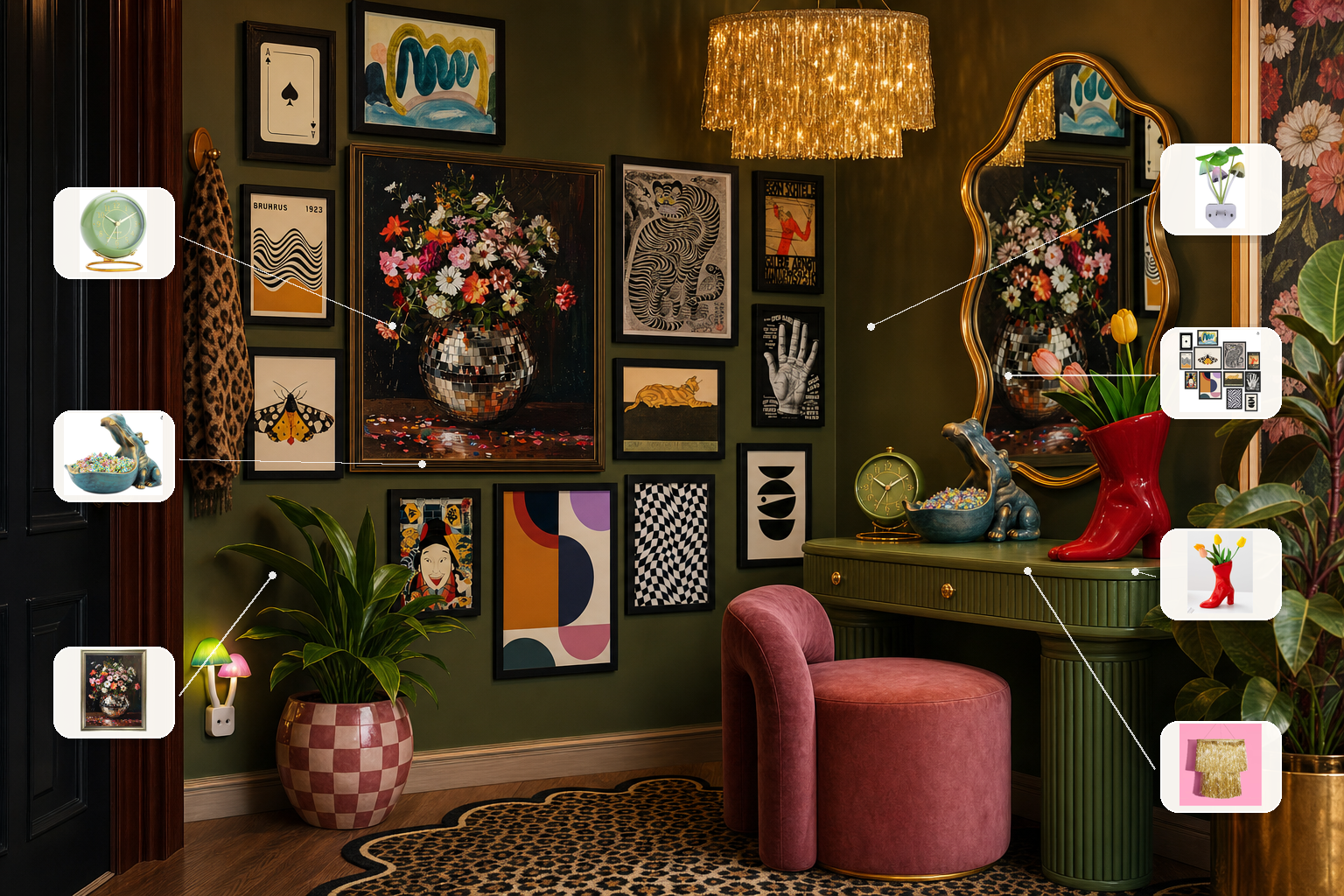
  • A Funky Maximalist Corner Built From Disco Florals, Gold Fringe, And Odd Little Treasures

    A Funky Maximalist Corner Built From Disco Florals, Gold Fringe, And Odd Little Treasures

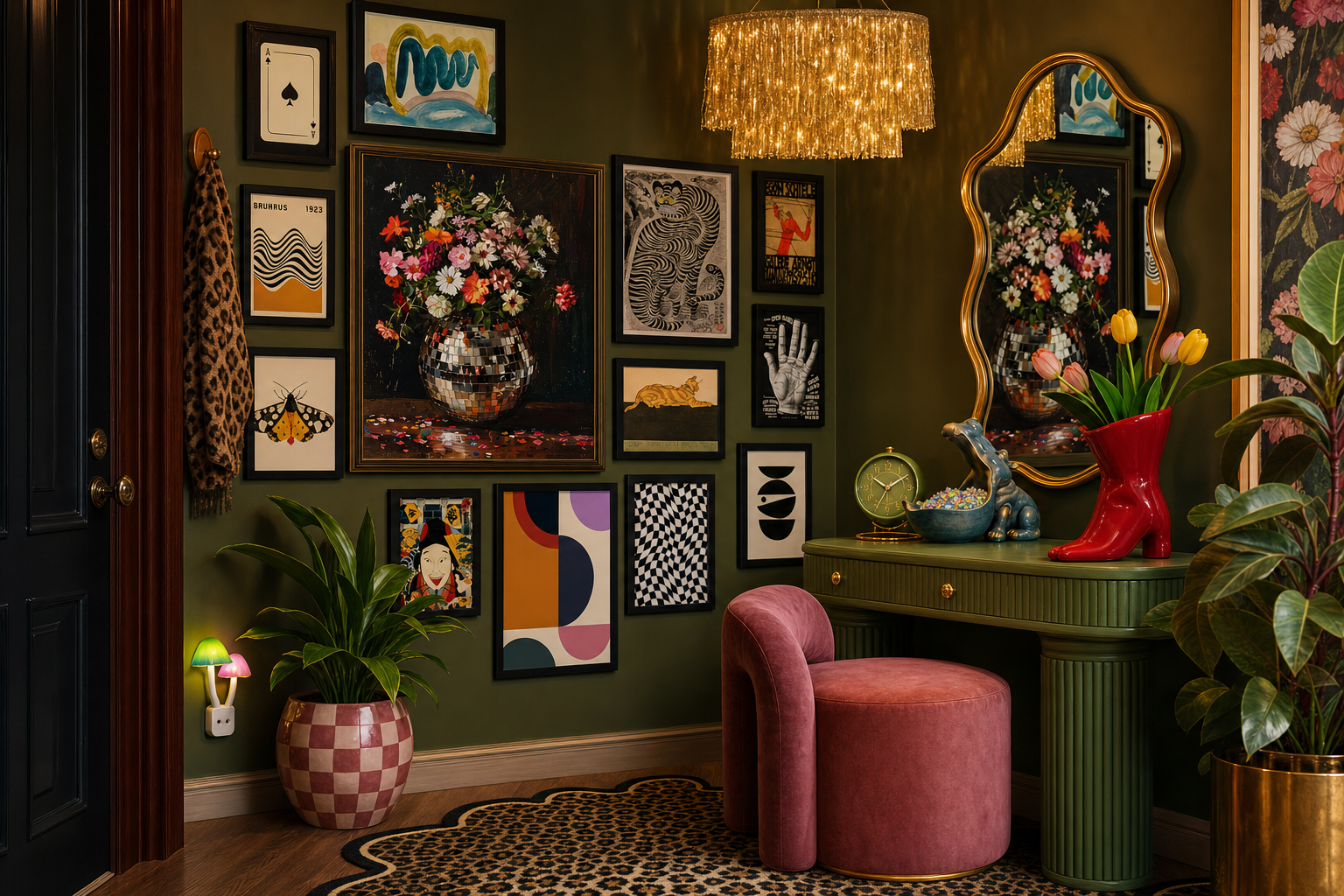
    Some corners want to be useful. This one wants to be noticed. The mood here is moody-glam maximalism with a sense of humor: dark florals, a wink of disco shine, glossy red ceramic, soft green vintage detail, and one extremely memorable blue hippo. It is not trying to look minimalist, timeless, or quietly expensive. It is trying to feel alive.

    The trick is that nothing here is random, even though the room should feel collected. Every piece has a job. The wall art builds the color story, the fringe adds height and movement, the small objects make the vignette feel personal, and the low glow keeps everything from going flat after dark. If you are working with a small apartment corner, a vanity wall, a narrow console, or the awkward spot beside a bookshelf, this is exactly the kind of high-impact decorating that makes a room feel designed without requiring a full makeover.

    Why This Maximalist Corner Works

    The whole look is built around contrast: dark and shiny, weird and polished, sculptural and soft. The disco floral art gives the corner its shadowy base, while the gold fringe catches light and makes the space feel theatrical. Then the smaller accessories bring in character. The green table clock and red boot vase have vintage-shop energy, but the blue hippo bowl pushes the vignette into something more personal and less predictable.

    Color is doing a lot of the heavy lifting here. The palette is not rainbow maximalism; it is more focused than that. Think deep floral tones, shiny gold, lipstick red, soft green, and saturated blue. Those colors do not match in the catalog sense, but they relate through intensity and finish. Glossy ceramic, metallic fringe, glassy clock details, and printed wall art all bounce light differently, which gives the corner depth even if the footprint is tiny.

    The Styled Room

    See How The Pieces Work Together

    Room Decode styled room with product callouts

    Vintage Green Table Clock

    The Vintage Green Table Clock is the quiet anchor in the middle of all this visual noise, which is exactly why it matters. In a maximalist corner, not every object can be the loudest object in the room. This clock brings a softer retro note with its green body and gold detailing, giving the vignette a little polish without competing with the disco florals or the red boot vase.

    Style it on a console, shelf, vanity, or stacked on top of a couple of art books so it has presence without taking over. The scale should feel intentional: not shoved into a gap, not floating alone, but tucked into a small arrangement with one taller piece and one sculptural piece nearby. If you buy through our links, we may earn a commission, and this is the kind of accessory that earns its keep because it makes the whole corner feel more collected, not just decorated.

    Blue Hippo Sculpture Bowl

    The Blue Hippo Sculpture Bowl is the “wait, what is that?” piece, and every good maximalist corner needs one. It gives the room a wonderfully strange focal point at tabletop level, which keeps the look from becoming too pretty or too serious. The saturated blue is especially useful because it cuts through the darker floral palette and adds a cool, playful counterpoint to the warmer gold and red accents.

    Use it like a candy dish, key bowl, matchbook holder, jewelry catchall, or simply let it sit empty as a sculpture. The important thing is to give it space to be funny. Don’t bury it behind a vase or crowd it with too many small accessories. Put it somewhere visible, preferably near the front edge of the console or shelf, so it reads as a deliberate odd little treasure rather than clutter.

    Disco Floral Wall Art

    The Disco Floral Wall Art is the piece that sets the entire mood. Dark florals bring drama and depth, while the disco-ball detail adds that tiny after-hours shimmer that makes the corner feel like a party waiting to happen. It is moody without being gloomy, glamorous without being stiff, and graphic enough to hold its own in a layered gallery wall.

    Hang it at eye level as the visual center of the arrangement, then let the rest of the wall build around it. Because the artwork already has contrast and shine, it can handle company: smaller prints, eccentric frames, and a little asymmetry will only make it stronger. In a small space, this kind of art does more than decorate a wall. It creates an atmosphere, which is the whole point of a maximalist corner.

    Mushroom Plug-In Night Light

    The Mushroom Plug-In Night Light is a small move with a big payoff. Maximalist rooms need layers of light, not just one overhead fixture blasting everything into flatness. A low plug-in glow near the console or outlet gives the corner a lived-in, slightly magical quality at night, especially when it catches the gold fringe or glints off glossy ceramic.

    The mushroom shape also keeps the room from feeling too polished. It adds a fairy-tale, vintage-novel kind of whimsy that works beautifully with the hippo bowl and boot vase. Place it close enough to the vignette that the light feels connected to the arrangement, but not so close that it visually clutters the tabletop. It should feel like a tiny atmospheric detail you discover, not a main event.

    Eclectic Gallery Wall Print Set

    The Eclectic Gallery Wall Print Set is the shortcut to density, and density is what makes maximalism feel convincing. One lonely print can look accidental; a layered wall reads intentional. By mixing a print set around the disco floral piece, you create a collected backdrop fast, with enough variation in color, line, and subject matter to make the corner feel personal.

    The key is to avoid hanging everything in a perfect grid unless the rest of the room is already very chaotic. For this look, a loose salon-style cluster works best. Let the disco floral art be the anchor, then stagger the smaller prints around it with a mix of frame finishes if you want more texture. Keep the spacing tight enough that the grouping reads as one bold composition, not a scattering of unrelated posters.

    Red Ceramic Boot Vase

    The Red Ceramic Boot Vase brings the hit of glossy color this corner needs. Red is powerful in small doses, and the boot shape gives it personality instead of letting it become just another vase. It is sculptural, a little cheeky, and strong enough to hold its own beside the blue hippo and dark wall art.

    Fill it with simple stems so the silhouette stays the star. A few tall branches, white daisies, dried grasses, or single-color faux stems will work better than an overly busy bouquet. You want height and movement, not floral chaos competing with the wall. Place it toward one side of the console or shelf to create an asymmetrical line that leads the eye up toward the gallery wall and fringe.

    Gold Fringe Chandelier Accent

    The Gold Fringe Chandelier Accent is what gives this small corner its sense of occasion. It adds shimmer, height, and movement without requiring a hardwired light fixture, which makes it especially useful for renters or anyone decorating an awkward corner that needs drama. Hung above the vignette, it creates a vertical moment that pulls the eye upward and makes the whole setup feel more immersive.

    Gold fringe works because it catches light in a softer, more playful way than a rigid metallic object. It can echo the gold details in the table clock while amplifying the disco energy from the wall art. Hang it where it has a little breathing room and can move slightly, whether that is above a console, near a vanity mirror, or in the corner by a reading chair. The goal is theatrical, not fussy.

    How to Pull It Together

    Start with the wall. Hang the Disco Floral Wall Art first, then build the Eclectic Gallery Wall Print Set around it in a tight, layered cluster. Once the wall has weight, add the Gold Fringe Chandelier Accent above or slightly to one side so the vignette has height. This is what turns a small corner into a scene rather than a pile of cute objects.

    Next, style the surface below. Use the Red Ceramic Boot Vase as the tall sculptural piece, the Vintage Green Table Clock as the polished vintage anchor, and the Blue Hippo Sculpture Bowl as the weird little treasure that makes the whole thing memorable. Finish with the Mushroom Plug-In Night Light nearby so the corner glows after dark. Keep the surface edited but not sparse: three to five objects, varied heights, glossy and matte finishes, and at least one piece that makes people smile.

    The final read should be glamorous, funny, and a little offbeat. Not cluttered. Not matchy. Not trying too hard. Just a compact maximalist corner with a moody wall, a shimmer overhead, and enough odd charm to make it feel like it belongs to someone interesting.

    The Decode

    This is the heart of the formula: one moody anchor, one reflective or metallic moment, one strange conversation piece, one sculptural color pop, and one low glow. That mix is why the corner feels collected instead of chaotic.

  • A Playful Maximalist Room Built Around Velvet, Citrus, And Strawberry Red

    A Playful Maximalist Room Built Around Velvet, Citrus, And Strawberry Red

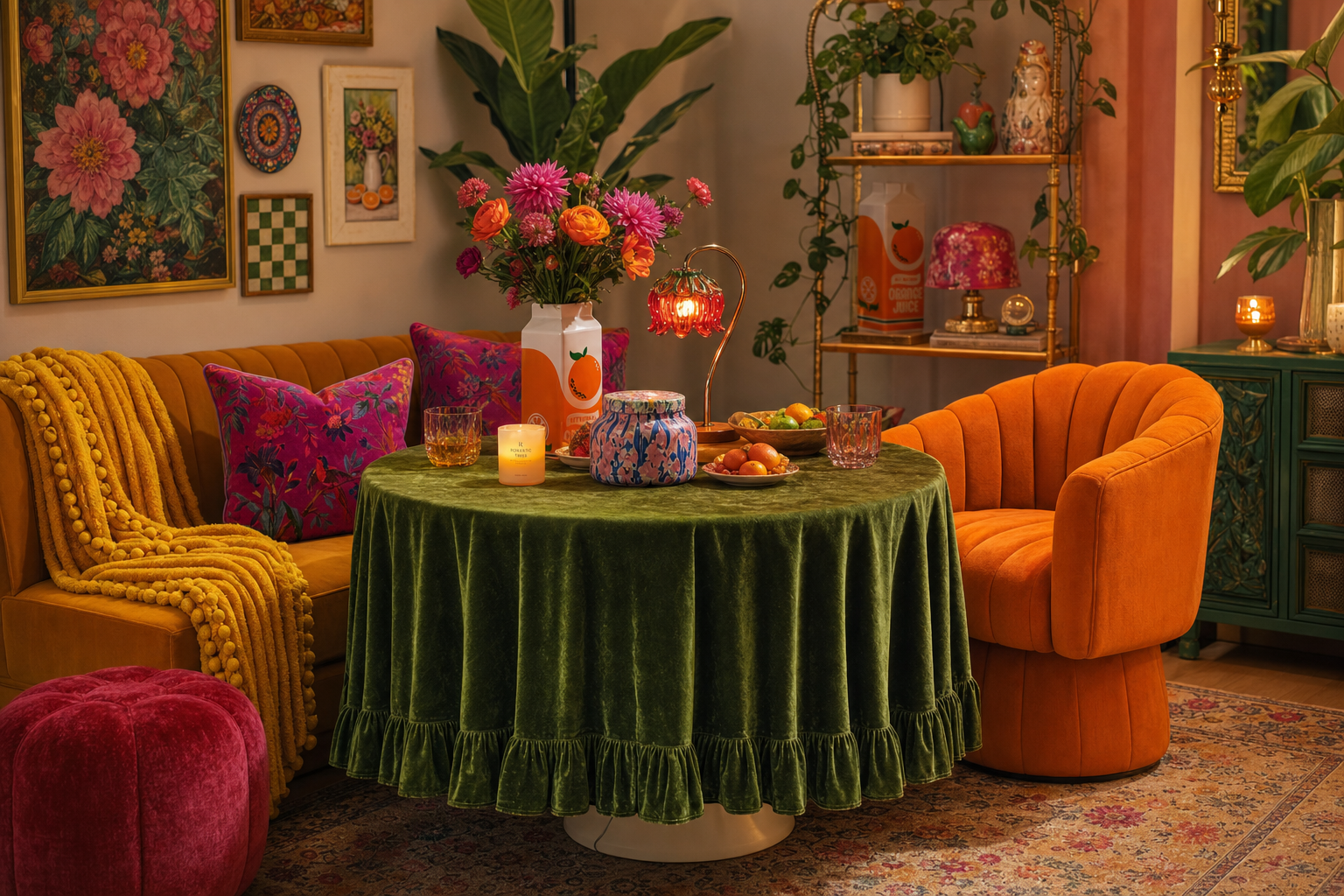
    This room is not trying to be quiet, and that is exactly the point. It has the charm of a sunny breakfast nook, the softness of a velvet lounge, and the visual wit of a space where a strawberry lamp and an orange juice vase are absolutely allowed to be the stars.

    The mood is playful maximalism, but not chaos. The palette is tightly edited around citrus orange, mustard yellow, strawberry red, leafy green, and a few romantic pink and blue notes. Everything feels touchable: velvet, ruffles, pom-poms, channel tufting, patterned ceramic, warm light. It is the kind of room that looks collected over time, even if you are intentionally shopping the look piece by piece.

    Why This Room Works

    The secret is that the color story has both heat and relief. Orange, mustard, burgundy, and red bring the energy; green velvet cools it down so the room does not tip into candy-store overload. The pinks and blues in the smaller decorative accents keep the palette from feeling too literal, adding movement without stealing attention from the stronger citrus tones.

    Scale matters here, too. The larger pieces carry texture and shape, while the smaller objects deliver the joke, the sparkle, and the personality. A sculptural chair gives the room its silhouette. A ruffled tablecloth creates drama across a horizontal surface. Then the vase, candle jar, lamp, pillow, and throw act like punctuation marks. If you purchase through affiliate links, we may earn a commission, but the design idea is simple: pick pieces that repeat color, vary texture, and make the room feel like someone interesting lives there.

    The Styled Room

    See How The Pieces Work Together

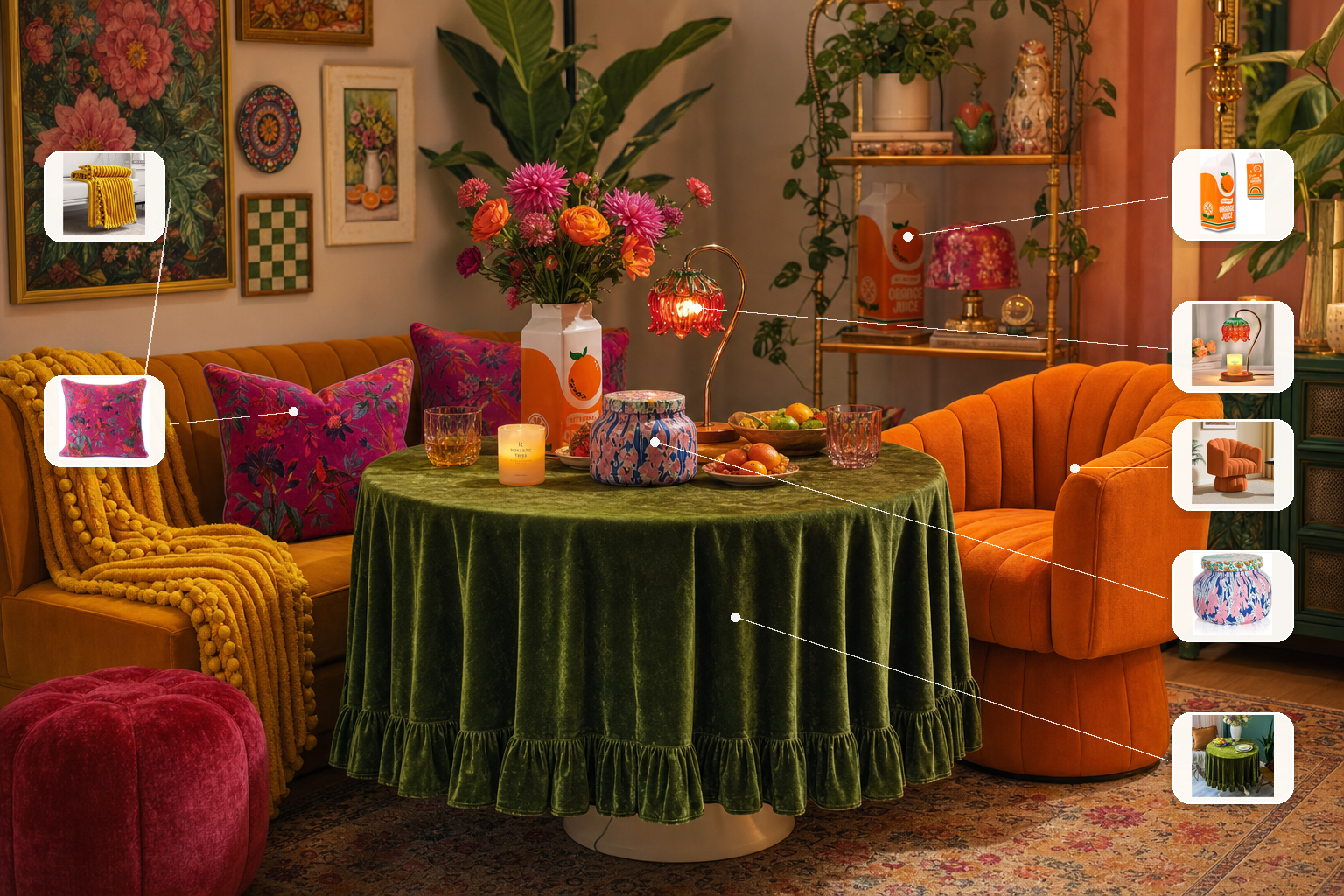
    Room Decode styled room with product callouts

    Mustard Pom-Pom Throw Blanket

    A mustard throw is one of the easiest ways to make a maximalist room feel warm instead of simply busy. This one works because the color is strong enough to stand up to orange seating and strawberry red accents, but mellow enough to read as cozy. Drape it across a chair, banquette, or the arm of a sofa so the mustard repeats the warm gold tones you are already getting from lighting, candlelight, and tabletop styling.

    The pom-pom edge is important. In a room full of saturated color, texture keeps the eye moving without requiring another print. The little rounded details echo the playful curves of the swivel chair and the novelty shapes on the table, so the blanket does more than add softness. It helps the whole room feel intentionally charming, not randomly colorful.

    Burgundy Floral Velvet Pillow

    The burgundy floral velvet pillow is the bridge piece. It connects the orange chair to the pink florals, deeper jewel tones, and berry-red accents without making the room feel color-blocked. Burgundy is especially useful in a citrus-heavy palette because it deepens the scheme. It says, yes, this room is cheerful, but it also has a little romance and weight.

    Velvet also changes how the color behaves. In daylight, the pillow can feel rich and floral; under a warm lamp, it becomes moodier and more jewel-toned. That shift is exactly what a layered maximalist room needs. Place it on the orange channel-tufted chair or against a green banquette so it can mediate between the hottest and coolest colors in the room.

    Orange Channel-Tufted Swivel Chair

    This is the piece that gives the room its memorable shape. The orange channel-tufted swivel chair is not just seating; it is a sculptural moment. The curved back, vertical channels, and rounded form soften the intensity of the color, making the chair feel plush and inviting rather than loud for the sake of being loud.

    Orange can be tricky in interiors because it demands attention, but here that is the advantage. Let it be the main seating statement and keep the surrounding pieces in conversation with it. Mustard warms it up, burgundy deepens it, green balances it, and strawberry red makes it feel cheeky. If you are building the room from scratch, start here and let the chair set the confidence level.

    Vintage-Inspired Orange Juice Vase

    The vintage-inspired orange juice vase is the wink in the room. Style it on a shelf, side table, or breakfast table with a few stems and let its novelty shape do the work of a much larger decorative gesture. It brings in citrus without relying only on color, which is why it feels more personal than simply adding another orange object.

    This is also a smart piece for renters or anyone decorating on a smaller budget. You do not need a massive art wall to give a room personality when your accessories have point of view. Keep the stems simple: a few pink tulips, red ranunculus, or even sculptural greenery would be enough. The vase already has the character; the flowers just give it a reason to be there.

    Strawberry Candle Warmer Lamp

    The strawberry candle warmer lamp is the small red accent that makes the whole setup click. Red can feel abrupt when it appears only once, but here it becomes intentional because the strawberry shape connects to the room’s fruit-inspired theme. It plays beautifully with citrus orange and mustard yellow, creating that sweet, almost dessert-table quality without turning the space childish.

    Just as important, it adds warm light at a lower level. Maximalist rooms need glow, not just overhead brightness. Place this on a side table, buffet, or shelf where it can cast a cozy pool of light across velvet, glass, or patterned ceramic. The result is practical, decorative, and a little theatrical — exactly what this room wants.

    Patterned Capri Blue Candle Jar

    Treat the patterned Capri Blue candle jar like a decorative object, not just a scent. The jar brings pink and blue movement into the tabletop mix, which helps loosen the palette. Without those cooler and softer tones, the room could become too dependent on orange, yellow, and red. The pattern adds a breezy counterpoint to all the plush velvet and saturated fruit color.

    This is a great example of using small-scale pattern to make a room feel collected. Set it near the strawberry lamp or orange juice vase, but do not line everything up too perfectly. A maximalist tabletop should feel styled, not staged. Vary the heights, let the candle jar overlap visually with flowers or books, and allow the pattern to peek out like a little surprise.

    Green Velvet Ruffle Tablecloth

    The green velvet ruffle tablecloth is the grounding piece. It cools down the oranges, yellows, and reds while still feeling dramatic enough to belong in the room. Green is doing a lot of work here: it references garden color, balances the fruit tones, and gives the table a plush foundation that makes every object placed on top look more deliberate.

    The ruffled edge is what keeps it from feeling too formal. Velvet can lean grand, but the ruffle makes it playful and a little eccentric. Use it on a breakfast table, game table, or small dining setup, then layer on the orange juice vase, patterned candle, and strawberry lamp. Suddenly the table is not just a surface; it is a designed moment.

    How to Pull It Together

    Start with the biggest color commitment: the orange channel-tufted chair or the green velvet tablecloth. Those pieces establish the room’s personality and give the smaller accents something to orbit. From there, repeat each major color at least twice. Orange appears in the chair and vase. Red appears in the strawberry lamp and burgundy pillow. Mustard appears in the throw and warm lighting tones. Green appears in the tablecloth and any stems or plants you add.

    Keep the styling layered but edited. Use one strong sculptural seat, one plush textile moment, one romantic pattern, and a few witty tabletop pieces. Mix heights on shelves and tables, lean into warm bulbs, and avoid making everything match too perfectly. The goal is a room that feels collected, cozy, and deliciously personal — maximalist, yes, but with a real point of view.

    The Decode

    The trick is not buying seven loud things and hoping they behave. It is choosing pieces that repeat the same warm citrus family, then grounding them with one plush green surface and one romantic floral note. That is what turns cute products into a room with a point of view.

  • A Maximalist Living Room You Can Build From Six Amazon Finds

    A Maximalist Living Room You Can Build From Six Amazon Finds

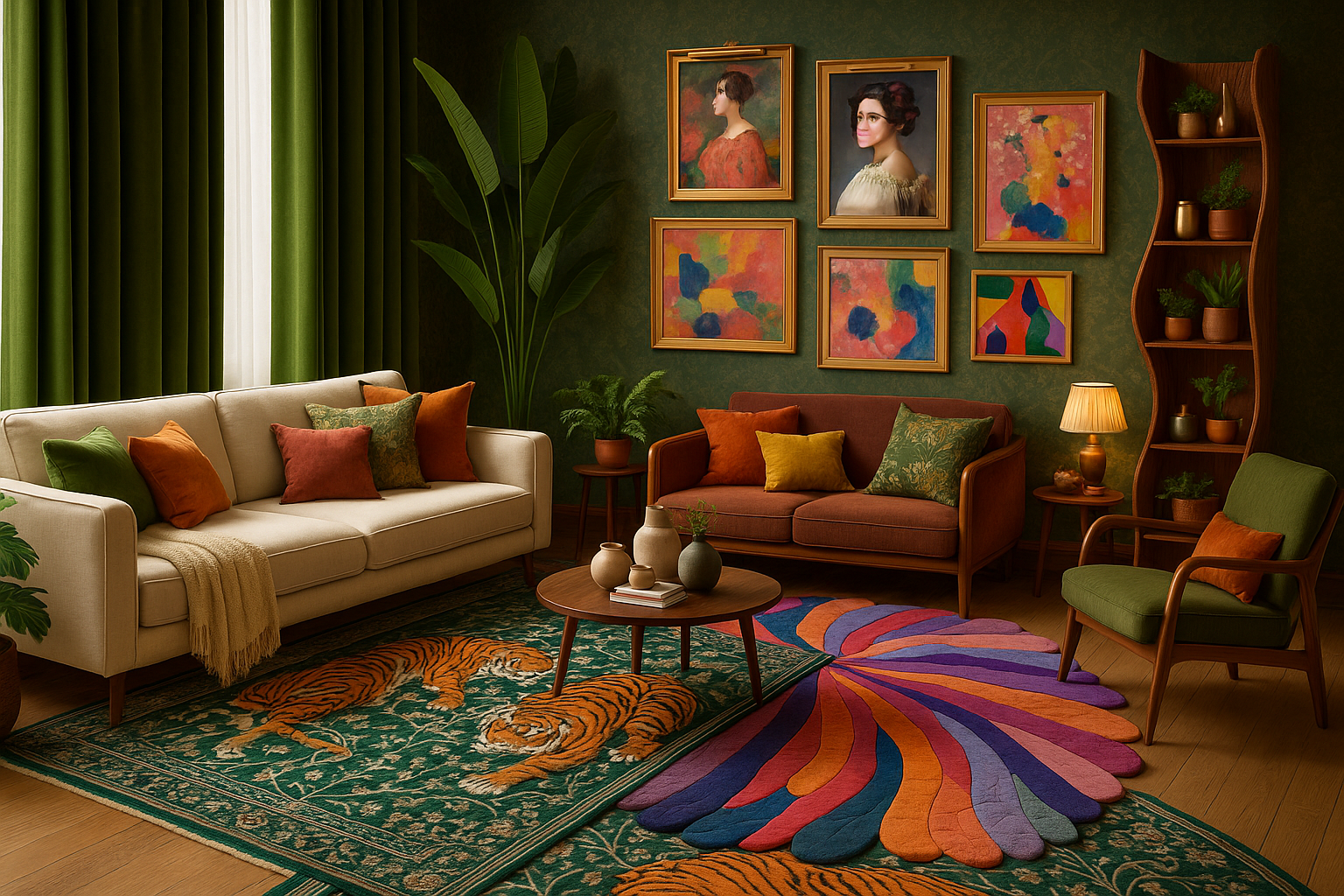
    Tiger print, gallery art, olive curtains, a sculptural shelf, a bird-of-paradise plant, and a petal-shaped rug make one fearless room feel intentional.

    Some living rooms whisper. This one absolutely does not. It has tigers underfoot, olive velvet at the windows, color-happy art on the walls, a wavy wood bookshelf, tropical leaves, and a petal-shaped rug that looks like it wandered in from a very chic storybook. It is maximalist, yes, but not messy. The trick is that every bold choice is doing a job.

    This is the kind of room that feels collected without requiring ten years of flea market patience. The pieces are expressive, affordable, and easy to source, which makes the whole look feel surprisingly buildable. If you buy through affiliate links, Room Decode may earn a small commission, but the design logic here is the real point: start with one fearless anchor, repeat your colors, mix shapes with intention, and let the room have a little drama.

    The Styled Room

    See How The Pieces Work Together

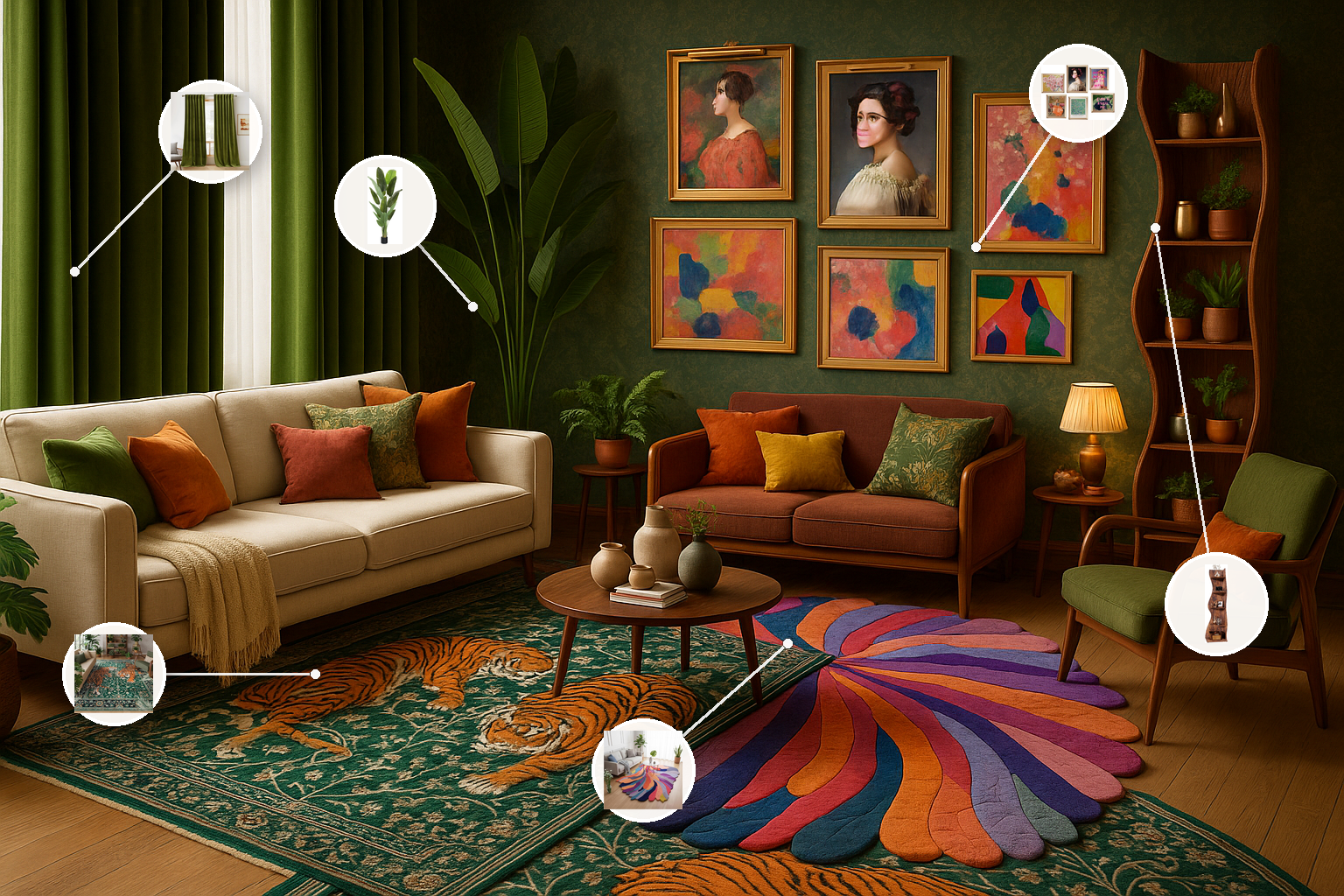
    Room Decode styled room with product callouts

    Why This Maximalist Living Room Works

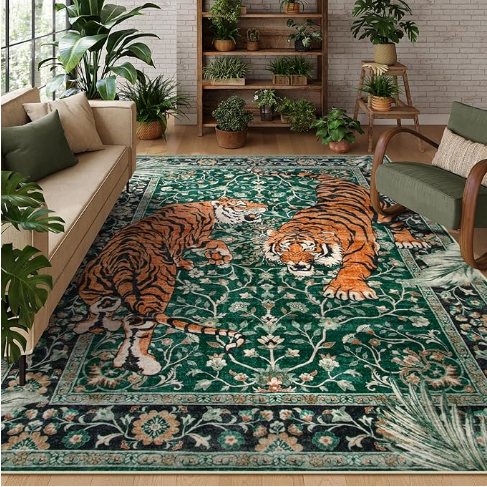
    The room succeeds because it has a clear palette hiding inside all that pattern. The tiger rug sets the terms: emerald green, black, cream, warm wood, and a flash of orange. Once those colors are established, the gallery wall, curtains, plant, shelf, and accent rug all feel like they belong to the same conversation. Nothing has to match perfectly. In maximalism, “related” is often better than “matching.”

    It also works because the shapes are varied. The rug brings organic botanical movement and animal motifs. The gallery wall introduces a grid of rectangles. The bookshelf adds a tall, irregular silhouette. The curtains create vertical softness. The bird of paradise gives the eye a large leafy pause. The petal rug adds a playful sculptural curve. That mix of hard and soft, flat and dimensional, patterned and solid is what keeps the room feeling designed instead of simply full.

    Green Tiger Botanical Washable Rug

    Start with the tiger rug. In a maximalist living room, the rug is not an afterthought you toss under the coffee table at the end. It is the map. This vintage-inspired green botanical rug gives the room its whole visual language: deep emerald, inky black, creamy neutrals, warm earthy tones, and those orange tiger moments that make everything feel a little more daring. It is bold enough to lead, but because the palette has depth rather than neon brightness, it still feels livable.

    The oversized tiger motifs are what make the room memorable. They add movement, humor, and a little bit of old-world eccentricity, which is exactly the sweet spot for modern maximalism. Use it as the largest rug in the space, ideally big enough that at least the front legs of the sofa and chairs sit on it. That scale matters. A small tiger rug can look like a novelty; a generous one looks like a design decision. Pair it with warm wood, black accents, cream upholstery, or even a velvet chair in olive or rust to pull the palette up from the floor.

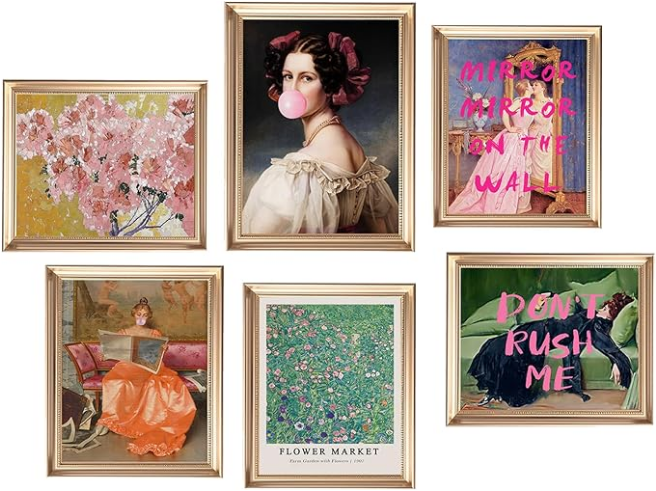
    Eclectic Maximalist Gallery Wall Art Set

    A good gallery wall can take years to collect. Or, if you want the look without the scavenger hunt, an eclectic art set can do the heavy lifting fast. This framed-look print set brings in the essential maximalist mix: portraits, botanical references, playful graphics, color, and a sense of visual rhythm. It makes the room feel layered immediately, which is especially useful if your furniture is still fairly simple.

    The important move is to echo the colors from the art elsewhere in the room. If the prints include pink, orange, green, and black, let those shades show up again in a pillow, a throw, a vase, a lampshade, or the smaller petal rug. That repetition is what turns “a lot of art” into “a point of view.” Hang the set above the sofa, around a media console, or beside the sculptural bookshelf. Keep spacing fairly consistent, but do not over-police the arrangement. A gallery wall should feel collected, not like it was measured by a nervous accountant.

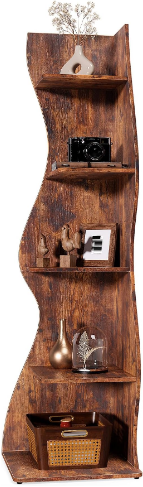
    LITTLE TREE Sculptural Wood Bookshelf

    The LITTLE TREE sculptural wood bookshelf is the piece that keeps the room from becoming flat. Maximalist rooms can easily become wall art plus rug plus pillows, but this shelf adds height, dimension, and a warm wood tone that grounds all the color. Its irregular, wavy vertical shape feels more decorative than a standard bookcase, which means it works as both storage and sculpture.

    Style it with restraint, which may sound illegal in a maximalist room but is actually the secret sauce. Give your favorite objects room to breathe: stacked books, a small lamp, a glossy ceramic bowl, a trailing plant, a strange little flea-market object, a framed mini print. The wood warms up the emeralds and olives, while the non-boxy silhouette breaks up the rectangles from the art frames, windows, and sofa. Place it near the gallery wall or opposite the curtains so the eye has a tall moment on more than one side of the room.

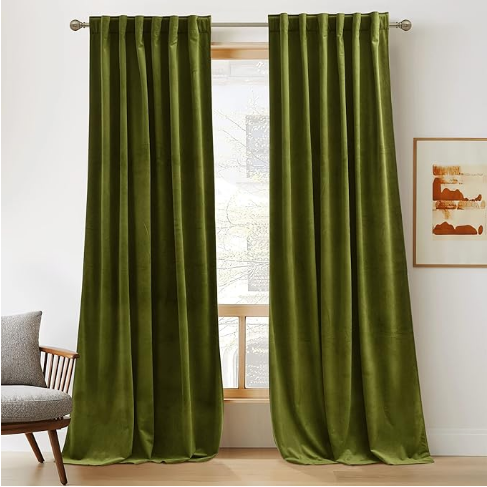
    Olive Green Velvet Room-Darkening Curtains

    Olive green velvet curtains are the fastest way to make this room feel finished and expensive. They add a major wash of color without introducing another busy pattern, which is crucial here. The tiger rug and gallery wall are already bringing the visual fireworks; the curtains deepen the palette and create softness around the edges. Olive is also a smarter choice than a brighter green because it feels moody, grown-up, and slightly vintage.

    Hang them high and wide. That is non-negotiable if you want the full effect. Mount the rod closer to the ceiling than the window frame, and extend it beyond the window so the panels can sit mostly outside the glass when open. The room-darkening weight gives them a heavy, plush look, which makes the living room feel more cocooned in the evening. Add warm lamps, and suddenly the tiger rug looks richer, the wood shelf glows, and the art feels like it belongs in a tiny jewel-box salon.

    Artificial Bird of Paradise Plant

    Every maximalist room needs a visual exhale. The artificial bird of paradise does that job beautifully. Its large glossy leaves add height, organic shape, and a tropical interior moment without asking you to become a plant parent. In a room full of small-scale detail, big leaves give the eye somewhere calm to land.

    Use it in a corner, beside the sculptural bookshelf, or near the window where a real plant might theoretically live. The scale is the point: tiny plants can get lost in a maximalist room, but a tall bird of paradise has presence. Put it in a substantial planter—black, terracotta, cream, or warm woven texture all work—and avoid anything too flimsy. The plant should feel like part of the architecture, not like a prop that wandered in for a photo.

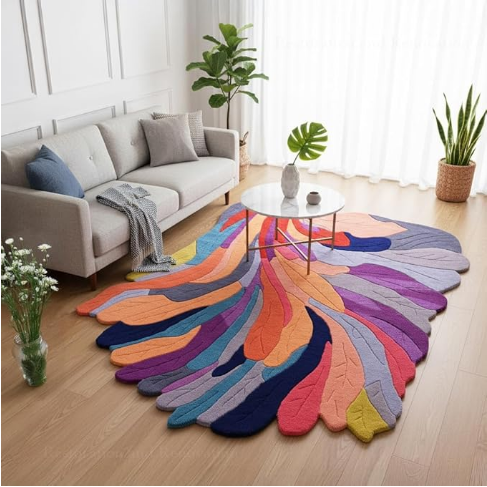
    Colorful Irregular Botanical Flower Rug

    The petal-shaped rug is the fun little wildcard. Because the main tiger rug is already a strong anchor, this colorful irregular botanical rug works best as an accent layer rather than the primary rug. Think of it in a reading corner, under a small side table, beside a lounge chair, or layered partially over a larger neutral area if your room has the space. Its sculptural shape adds a contemporary note that keeps the room from feeling too vintage-themed.

    The key is placement. Do not drop it randomly in the middle of the tiger rug and hope for magic. Give it a purpose: define a corner, soften the edge of a chair, or create a small color moment near the bookshelf. If it includes pinks, greens, oranges, or creams, let it speak to the gallery wall and the tigers rather than compete with them. In maximalism, a second rug can absolutely work, but it needs to feel like punctuation, not a second paragraph shouting over the first.

    How to Pull It Together

    Begin with the tiger rug and let it dictate the room. Choose a sofa or main seating in a quieter tone—cream, camel, olive, charcoal, or warm brown all make sense. Then bring in the olive curtains to frame the space and add height. Once those two large color fields are in place, the room has enough structure to handle the gallery wall, the sculptural shelf, the bird of paradise, and the accent rug.

    Repeat your colors at least three times. Green appears in the rug, curtains, plant, and art. Orange appears in the tiger motifs, gallery prints, and possibly a pillow or lamp. Warm wood appears in the shelf, frames, side tables, or woven accessories. Black can show up in picture frames, a floor lamp, a tray, or a side table leg. This repetition is what makes a maximalist room feel intentional rather than chaotic.

    For lighting, avoid one harsh overhead fixture doing all the work. Maximalism looks best with layers: a floor lamp near the reading chair, a table lamp on or near the bookshelf, and maybe a small picture light or sconce effect near the gallery wall. Warm bulbs will flatter the olive velvet, make the wood richer, and keep the greens from going cold.

    Finally, edit by scale, not by personality. You do not need fewer interesting things; you need the right mix of big, medium, and small. Let the tiger rug, curtains, bookshelf, and plant be the large gestures. Let the gallery wall and petal rug be the expressive middle notes. Let books, ceramics, pillows, and odd little objects be the details. That is how you get a fearless room that still feels welcoming—the kind of maximalism that says yes to more, but only when more has a plan.

    Shop The Decode

    The Pieces That Make The Room

    Green Tiger Botanical Washable Rug

    Room Decode Pick

    Green Tiger Botanical Washable Rug

    Best for: Anchoring the whole room with pattern and color

    Start with the rug because it gives the room its palette: emerald, black, cream, warm wood, and a flash of orange from the tigers.

    Check price on Amazon

    As an Amazon Associate, we may earn from qualifying purchases.


    Eclectic Maximalist Gallery Wall Art Set

    Room Decode Pick

    Eclectic Maximalist Gallery Wall Art Set

    Best for: Creating a collected gallery wall without hunting for vintage pieces one by one

    The art set makes the room feel layered immediately, especially when you repeat its pink, green, and orange tones elsewhere.

    Check price on Amazon

    As an Amazon Associate, we may earn from qualifying purchases.


    LITTLE TREE Sculptural Wood Bookshelf

    Room Decode Pick

    LITTLE TREE Sculptural Wood Bookshelf

    Best for: Adding storage that also acts like sculpture

    The wavy vertical shape breaks up all the rectangles in the room and gives books, plants, and odd little objects a proper stage.

    Check price on Amazon

    As an Amazon Associate, we may earn from qualifying purchases.


    Olive Green Velvet Room-Darkening Curtains

    Room Decode Pick

    Olive Green Velvet Room-Darkening Curtains

    Best for: Making the room feel cozy, dramatic, and finished

    Curtains are the easiest way to make maximalism feel expensive because they add height, softness, and a big wash of color.

    Check price on Amazon

    As an Amazon Associate, we may earn from qualifying purchases.


    Artificial Bird of Paradise Plant

    Room Decode Pick

    Artificial Bird of Paradise Plant

    Best for: Adding height and organic shape without plant-care drama

    The plant gives the room breathing room. In a pattern-heavy space, big leaves act like a visual reset.

    Check price on Amazon

    As an Amazon Associate, we may earn from qualifying purchases.


    Colorful Irregular Botanical Flower Rug

    Room Decode Pick

    Colorful Irregular Botanical Flower Rug

    Best for: Layering a playful shape into a reading corner or seating zone

    Use the petal rug as a smaller accent layer so the room gets a second hit of color without competing with the main tiger rug.

    Check price on Amazon

    As an Amazon Associate, we may earn from qualifying purchases.