Room Decode may earn a commission when you buy through links on this page. Product links are placeholders for now and will be updated with live affiliate links. As an Amazon Associate I earn from qualifying purchases.
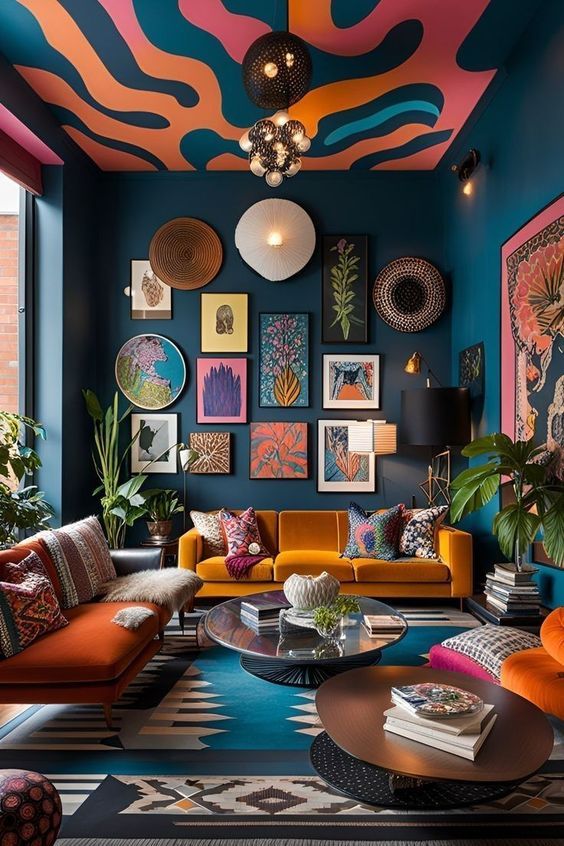
Most people decorate the walls, pick a sofa, add a rug, and stop there. This room keeps going. The ceiling becomes part of the design, the wall art creates movement, and the furniture repeats the same saturated colors so the space feels wild but not messy.
The lesson is simple: maximalism works best when the room has one dramatic idea, then every other choice supports it. Here, that idea is overhead pattern.
What Makes This Room Work
The painted ceiling is the star, but the room does not rely on paint alone. The teal walls, mustard sofa, orange chaise, layered pillows, woven wall pieces, and patterned rugs all speak the same visual language. Nothing is quiet, but everything is connected.
1. Start With A Ceiling That Acts Like Art
A maximalist ceiling changes the entire mood of a room. Instead of leaving the largest surface blank, this space uses organic waves in coral, peach, teal, navy, and pink. The curves soften the darker walls and make the room feel taller, more intentional, and more immersive.
If painting a ceiling feels intimidating, try the same idea with removable wallpaper, oversized decals, or a painted border around the ceiling edge. The goal is not perfection. The goal is to make the top of the room feel designed.
2. Use Dark Walls To Hold The Color
Dark teal walls are doing serious work here. Bright furniture and art can feel chaotic against plain white walls because every object shouts at full volume. A saturated wall color creates a visual container. It lets orange, magenta, mustard, and turquoise feel rich instead of random.
3. Mix Wall Art With Texture
The gallery wall is not only framed prints. It includes woven baskets, round textures, botanical art, small illustrations, and a large textile-style piece. That mix keeps the wall from feeling like a grid. It feels collected over time, which is exactly what maximalism wants.
4. Repeat Shapes, Not Just Colors
Notice the circles: woven discs, round coffee table, globe-like pendant lights, rounded plant leaves, curved ceiling shapes. Repeating a shape is one of the easiest ways to make a busy room feel deliberate. Even when the colors are loud, the eye recognizes the pattern.
5. Ground It With Low, Loungey Furniture
The furniture keeps the room from feeling like a museum. Low sofas, patterned pillows, layered throws, and stacked books make the space livable. The ceiling and walls bring the drama; the seating makes it comfortable enough to actually use.